Quick navigation
If you own a leasehold flat, you might be thinking of asking the freeholder of the building to provide you with a landlord’s certificate that allocates the burden for paying remedial or cladding work costs at your property. Not having this certificate can make it harder to attract buyers to your home but this guide shows how a fast and fair sale is still achievable.
- What is a landlord’s certificate?
- Information required in a landlord’s certificate
- Problems with not having a landlord’s certificate
- Is a landlord’s certificate required to sell your flat?
- How to find a buyer for your flat without a landlord’s certificate
- Selling without a landlord’s certificate: top questions
What is a landlord’s certificate?
If you’re the owner of a flat in a building that is least five storeys or 11 meters tall, then your landlord – typically the freeholder owner of the property – may have to provide you with what’s known as a "landlord’s certificate" to provide clarity on the costs of remedial work at your home.
The concept of the landlord’s certificate was created by Parliament through the Building Safety Act of 2022, which came into effect in June of that year, as the law firm Tees notes.
Certain leaseholders that qualify are able to seek this document from their landlord, and it allocates responsibility for the costs of building external cladding at the property and/or remedial work that may need to be done. As you’ll see in this guide, the information required in this document can be quite extensive, and landlords are still trying to adjust to this duty.
A leading reason for the creation of the landlord’s certificate was the 2017 fire at the Grenfell Tower block of flats in London, in which 72 people died. The disaster highlighted the problem of inadequate cladding at the building that did not meet certain requirements, making it easier to ignite than safer material.
Parliament created the landlord’s certificate to better protect leaseholders that qualify from being responsible for the often very high costs of remediating long-running safety issues like poor quality cladding or other defects with buildings that include several flats. The document works by helping leaseholders to avoid such large bills and to put the burden on the landlord to fund the necessary repair work to resolve problems that exist due to past issues at the building.
Keep reading to learn more specifics about what’s required in this document and whether it’s required before you can sell your flat. You’ll also get top tips on how to decide on which method you want to use for attracting a competitive and speedy offer from a buyer.
Information required in a landlord’s certificate
Your landlord has a legal obligation to provide you with a landlord’s certificate within four weeks of you requesting the document, within four weeks after you notify them that you are planning on selling your flat, within four weeks of the landlord learning about a defect at the property that is not addressed in a prior certificate, and whenever the landlord intends to have you pay for a share of the expenses involved with the remediation work through your service charge.
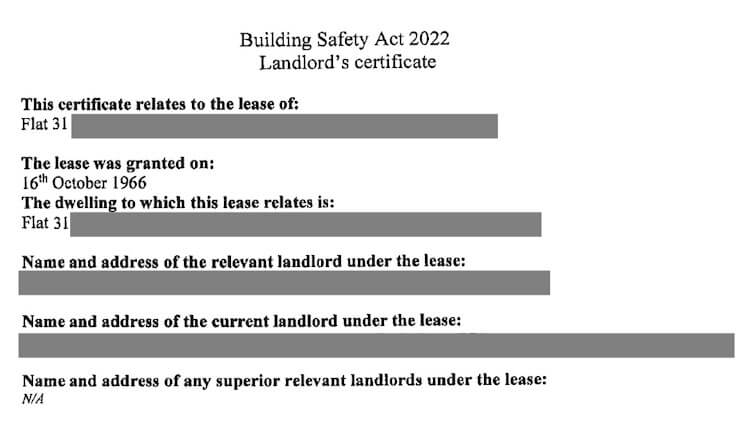
One online template from the UK Government for a landlord’s certificate shows just how detailed these documents can be, asking several questions about the building defect at issue, the leaseholder’s obligations, remedial work done and more.
It also asks for a number of supporting documents to back up the answers to some of the questions, for example evidence that work has been, proof of the costs involved, statements from financial professionals like a chartered accountant, and various other items.
If the landlord does plan on trying to use your service charge – established in the leasehold agreement that you will have signed when you bought your flat – then they need to produce a complete and accurate certificate before they are able to do this.
Problems with landlord’s certificates
If you are looking to sell your flat and it qualifies for the right to seek a landlord’s certificate, you should be aware of several problems that can arise throughout the process of trying to get this document.
Because there is often such an extensive amount of information requested through the questions and supporting documents with this document, it can create a huge workload for your landlord. They may not have a lot of free time to collect the necessary information, or to have a legal professional do it for them, and could take many weeks to complete it.
If you are determined to have the landlord’s certificate in your hand before attempting to sell your property, this will inevitably delay your timeline for finding a buyer, which will not be a preferred outcome for those flat owners who are looking to sell as speedily as feasible.
Whilst the government has taken some step to revise and clarify the obligations that landlords face with this document, the overall process remains a headache for landlords, according to Hogan Lovells.
As a result, you could find that your landlord has no interest in doing the work necessary to fill out the certificate, potentially creating delays as you attempt to sell your flat.
Or another outcome could be that the landlord either accidentally or deliberately provides inaccurate answers to the questions required for the certificate. This would also risk complications for your attempts to sell the property, particularly if incorrect information on the certificate puts an increased burden on you to pay some of the costs for remedial work.
Is a landlord’s certificate required to sell your flat?
When you are thinking about selling your flat, whether that’s in a building with a lift or not, you might be wondering whether it’s mandatory to have a landlord’s certificate ahead of attempting to sell your home.
The good news is that you are not obliged under law to obtain this document and have possession of it before you start to look for buyers for the property. There are no restrictions on leaseholders being able to sell a flat even if their home qualifies for the certificate.
If your landlord fails to provide the certificate within a reasonable time after you have requested it, then this could result in a presumption under the law that they will be responsible for the specific defect at the building where your flat is located. Therefore, they might be unable to impose any charges on your flat that they would otherwise have pursued to try recouping some of the costs of the remedial work, as JB Leitch Solicitors says
f you have tried to obtain a landlord’s certificate but they are refusing or are taking too long, you can then move on to the next step which is choosing how you would like to sell your flat.
How to find a buyer for your flat without a landlord’s certificate
As this guide shows, you don’t need to have a landlord’s certificate before selling your flat, and if this scenario applies to you then you can move on to the next key step, which is deciding whether to sell at an auction, to a quick buyer, with an estate agent or without any assistance.
You should write down your main priorities with the sale, which can include whether you are willing to pay any fees, how long you can wait to find a buyer and your preferred sale price. Then you should compare these factors against the specific details of the four approaches below and this should help you with finding the one that is the closest match to your wants.
Note that there are prominent advantages and disadvantages with each of the selling choices, such as the benefit of not having to pay any commission when you sell to a zero-fee quick home buying company, or the drawback of waiting many months to sell when you do so on your own.
Selling at an auction
Auctioneers will be responsible for the main tasks with trying to find a buyer for your home, which begins when they put together a listing that describes the flat and includes photographs of it. They’ll advertise this to get buyers interested ahead of the auction taking place, which they will host. And if your home sells at the auction, they will oversee the important final steps.
For putting in all this effort, the average auctioneer will require that you pay them commission at about 2.5 percent of your home’s sale price. This is taken immediately out of the sale proceeds, which will add to your expenses. If you are looking to reduce your costs as much as possible with the sale of your flat, you might want to think about some no-fee alternative options.
There are some auctioneers that may be open to having the winning bidder pay a share of your auction costs, or to reduce their rate of commission below 2.5 percent, which are two ways to lower the total expenses. It’s always worth inquiring with individual auctioneers about these possibilities, just note that other companies may charge an even higher rate of commission.
Another important consideration is choosing the right reserve price, which is the lowest possible price you’re willing to accept for your flat. If you only get a single bid at the reserve price, this is a binding legal deal to sell your home and the bidder could sue to enforce it if you try to walk away from the sale once the auction ends. That’s why you need to calculate a reserve price that should produce some profit from selling your flat, even after deducting the auctioneer’s fees.
It can take a long time to sell your flat this way because there will be a wait of many weeks or more between when you decide to sell using this method and when the auction takes place. If the property does sell, the buyer then has about 28 days to sign all of the relevant legal documents and complete the other steps required in order to finalise the purchase.
You might be able to persuade an auctioneer to set a shorter deadline than 28 days for the buyer to do these tasks, but others may give them even more time for these actions.
Some companies may offer you the choice of either a traditional or modern method of auction. If you choose the traditional method, your listing will be advertised ahead of the auction and then people will have a limited time on the day of the auction to bid on your home, with the top price bid at the end of the auction being deemed the winner and person buying the flat. The modern method allows people to place bids on your flat 24 hours a day, seven days a week whilst your listing is active, and the top price bid when the listing expires is deemed the winner.
Selling to a quick buyer
Quick buyers are so-called because they have the money available to buy almost any type of freehold or leasehold flat or other home right away, with no waiting a long time to get a mortgage to pay for the transaction. That results in a typical selling timeline of just a few weeks, which includes the crucial late steps of exchanging contracts and paying you the proceeds.
These companies, like LDN Properties, also never charge owners any commission when they sell their flats to them, which will help you as try to reduce your expenses with selling. That compares well to selling either via an estate agent or at a property auction, which are two choices that will require you to pay fees which will be deducted from the final sale proceeds.
You’ll also find that quick home buyers are able to make competitive and swift offers to buy properties no matter their age, condition, location, shape, size, type or with any problems.
Beyond flats without a landlord’s certificate, LDN Properties for example has purchased and made offer for many varied homes since its founding in 2003, including houses with a septic tank, properties located near to railway lines, prefabricated homes, converted flats, houses with an infestation, inherited retirement properties, homes that are near to a mobile telephone mast, penthouse flats, houses that have solar panels, flats with extensive dry rot, lock-up garages and many other property types.
And selling this way is a no-hassle, streamlined and stress-free process, starting when you contact the quick buyer about selling your flat. Within an hour of talking with them you should receive an initial price quote for your home, and you’ll have at least a week to consider it.
The next step would be for one of the company’s representatives to visit your flat and inspect it before they make a final offer. And this would be the only such viewing that you would need to have at your home, compared to potentially dozens of viewings with other selling options.
Then the quick buyer will make a final offer and, if you accept it, they’ll move rapidly to work with your solicitor or other legal representative to exchange contracts and complete the sale.
Selling with an estate agent
Another approach for selling your flat would be doing so using the services of an estate agent, which can help with reducing the amount of work you’d have to put in to finding a buyer.
The estate agent will be responsible for developing a listing, advertising this in their office, in local newspapers and online, scheduling viewings and taking potential buyers on a tour of your property, hearing offers from people and ideally guiding one to the exchange of contracts. Not having to do any of this work can be a great way to reduce your stress when selling.
But this method does have the drawback of often being relatively slow, and you should not be surprised if your home remains unsold after many months or even more than a full year. Also, a buyer can make an offer but then later rescind it, making the sale fall apart, which they can do without any penalties if you have not yet exchanged contracts. This would extend your selling timeline because you would need to begin again with your search for a new buyer.
Another downside of selling this way is that you will have to pay commission to the estate agent if they succeed in finding a buyer for your flat. The usual rate that estate agents charge is between 1.15 percent and 1.40 percent of your home’s eventual sale price, and this is taken out of the final sale proceeds immediately, adding to your overall expenses with selling.
Selling without any assistance
Or you could attempt to find a buyer for your flat without any third-party help, which puts the onus on you to handle every task needed to sell the property – from making and marketing a listing to organising viewings, hearing offers and hopefully taking one to completion.
It’s only advised as an option for selling if you have managed to find a buyer for a flat without a landlord’s certificate in the past, or you have a similarly experienced friend or family member that is open to helping you out with searching for a buyer at no cost to you. If not, there’s the risk that this could take up a lot of your time and become an incredibly stressful situation.
Selling on your own can also be among the slowest of the four options outlined in this section, and it may take over a year to find a buyer. And someone can make a serious offer but then change their mind for whatever reason and withdraw it – so long as contracts have not yet been exchanged, they can do this without being subject to a penalty. This would add even more time to your schedule for selling because you would have to start over with seeking a buyer.
This approach for selling does have the advantage that there is no auctioneer or estate agent that you’ll be required to pay commission, which helps with reducing your costs. But you could find that this financial saving is cancelled out by the money that you end up having to spend on advertising the listing for your home and other steps involved with trying to find a buyer.
If you are committed to avoiding paying any commission with selling but think that attempting to sell on your own will take too long, you may want to consider selling to a quick home buyer. These companies never charge homeowners any commission when purchasing their properties, so you’d get the same beneficial result of not having to pay any fees when selling.
But you’d get an extra perk of being able to secure a much swifter sale compared to attempting to find a buyer on your own. That’s because quick buyers, as the name suggests, can complete the purchase of most properties very speedily – usually within just a few short weeks after you first get in touch with the company and ask for a free quote for the price they’ll offer.
This means getting in touch with LDN Properties or another quick buyer could therefore be a streamlined, zero-stress and straightforward alternative for selling your flat.
Selling without a landlord’s certificate: top questions
The friendly home buying experts at LDN Properties have made offers for flats without landlord’s certificate. Here you’ll see our responses to some of the most common queries from owners.
Your top questions when selling a flat without landlord’s certificate
If you are the owner of a leasehold flat that is within a building at least 11 meters or five storeys tall, you might qualify to ask your landlord to provide a certificate that will help to clarify whether you might potentially have some liability to pay through your service charges for work that is done on the property to repair a defect, such as replacing cladding.
The landlord’s certificate provides several questions about the defect that exists at the property where your flat is located, as well as seeking information on financial questions and liability issues regarding the work done to remediate whatever the issue might be. And by law the landlord is required to provide you with this document if you qualify for seeking it.
Because your landlord could take a very long time to answer the questions and collect the information necessary for the document, and if you are determined to sell with the certificate then this will significantly extend your selling timeline. Also, if your landlord makes errors with the document then you may need to challenge and resolve these before selling.
Yes, whilst the landlord has a legal obligation to provide you with the certificate if you qualify to ask for one, you do not face any restrictions on being able to seek a buyer for your flat with or without this document. Indeed, if a landlord fails to give you the certificate then the presumption becomes that they are entirely responsible for the costs associated with any repair work.
You usually have four methods to choose from for selling your property, and they are selling at an auction, selling to LDN Properties or another quick home buyer, selling without any third-party assistance or selling with an estate agent. You should read this guide to learn about the specifics of each approach because they all their own unique pros and cons.
If you decide to sell your flat to a genuine no-commission quick buyer, such as LDN Properties, then you will not be required to pay any fees and you can count on receiving the full sale proceeds, or you could sell without any help and also avoid commission that way. Selling via an estate agent or an auctioneer will require that you pay them fees if they sell your flat.
The speediest approach for selling your home will often be contacting LDN Properties or another quick buyer because they should be able to complete the entire process in just a handful of weeks. By contrast, the other methods of selling without any help, selling with an estate agent or selling at a property auction could all take at least several months.