Quick navigation
If you are experiencing drainage problems at your house, flat or any other type of freehold or leasehold property, you might discover that this creates some additional complications when trying to sell the home. This guide explains those issues and also outlines steps that you could take in order to increase your chances of selling the property for a fast and fair offer.
- Having drainage problems at your leasehold or freehold home
- Your duty to tell buyers about drainage problems at your flat or house
- Why it can be harder to sell a property with drainage problems
- Should you fix drainage problems before trying to sell your home?
- Four methods for selling a home that has drainage problems
- Top queries about selling a property with drainage problems
Having drainage problems at your leasehold or freehold home
Structural problems with a property can create challenges for homeowners when trying to sell a leasehold or freehold house, flat or other residential building – and drainage problems, whatever the size of the issue, could deter some buyers from making an offer on your property.
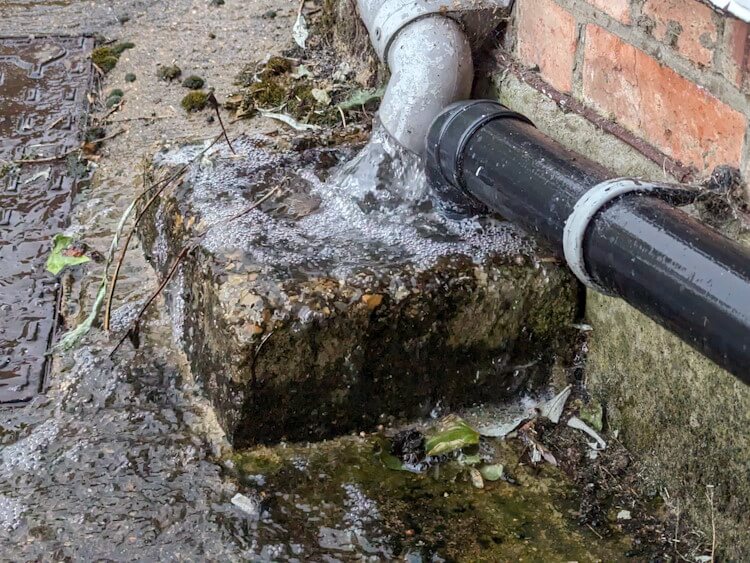
Drainage is the system of pipes inside your home through which wastewater from the kitchen, bathroom and elsewhere is taken out to the local sewer system. Drainage problems at your property could be relatively minor and easy to fix, or they may be extensive and have the potential to cause structural damage to your house or flat if left untreated.
As the My Plumber website details, some of the common drainage problems that can affect homes are blockages in the pipes that lead to water backing up and foul smells; cracks or other faults in pipes that result in water leaking into the home’s structure; roots from trees growing and causing damage to the pipes, which in turn could create leakage that harms your property.
The first signs of a drainage problem at your property can be bad smells from the blocked wastewater, experiencing very slow drainage of water from your bath, toilet or sinks, or hearing a gurgling noise whenever you try to drain any wastewater out of the home.
Beware that some drainage problems, like broken pipes, may be harder to detect until they start to cause noticeable damage within your home, like stains on the walls, ceiling or floors.
Some properties located in the countryside might drain their wastewater into a septic tank, and these can also develop complications that can result in blockages, leakages and related issues.
Your duty to tell buyers about drainage problems at your flat or house
Whenever a homeowner wants to sell their leasehold or freehold property and they are aware of existing drainage problems with the flat or house, they must disclose this issue to buyers.
If someone is interested in potentially buying your home, you will need to fill out a Property Information Form, also known as a TA6 form. This is essentially a lengthy list of questions about your property, its history, any current issues including structural problems, and more, and it’s designed to give the prospective buyer as much detail as possible about your flat or house, as The Law Society notes.
The TA6 form is not something that you can choose to ignore, and it’s also that law that you must answer all of the questions on the form in as much detail as possible.
If you know about a drainage problem at your property but you withhold this information from the TA6 form – for example, if you think hiding it will make selling the home easier – then you could face legal action and penalties when the buyer discovers the issue when they move in. That’s why being honest and direct with your TA6 form answers is always the best option.
Why it can be harder to sell a property with drainage problems
Whatever the reason you have for selling your home – and that could include many varied scenarios like moving overseas, trying to stop repossession of the property, upsizing or downsizing to your next dream home and more – you may find it harder to sell due to the drainage problems.
One explanation for why a buyer may not look favourably at your home is that they will be worried about the potential existing and future structural damage that the drainage problem might have caused. They could fear that this damage will appear after they purchase the property, and possibility cost them a lot of money, time and effort to fix. This is a concern that buyers might have regardless of whether you fix the problem before selling your home.
If you decide to sell the house or flat without first fixing the drainage problem, this can also lead to another hurdle with selling. That’s because some prospective buyers may conclude that fixing the issue as the home’s next owner is not something that they want to do, and this factor alone can be enough to make them lose interest in making an offer to buy your property.
And other buyers could simply believe that your home has a stigma because of the existence of a drainage problem, which may be a dealbreaker preventing them from making an offer. There’s little you can do to try and convince this type of potential buyer from changing their mind.
Even though there are some complications associated with trying to sell a flat or house that has drainage problems, it will not be impossible to eventually find a buyer. You have some options available, such as getting in touch with a quick home buying company like LDN Properties, who should be able to complete the purchase of your property within just a few short weeks.
Should you fix drainage problems before trying to sell your home?
If you are aware of drainage issues at your leasehold or freehold house or flat, you’ll need to make a decision on whether to address the problem before attempting to sell.
Spending effort, money and time on repairing a drainage problem at your property before selling does have some advantages. It would help to eliminate the possibility of the drainage issue being identified as an ongoing problem during the survey part of the selling process. And it may remove the stigma about the problem that could be causing some buyers to lose interest in your home.
A further benefit of fixing a drainage problem before selling is that it will also prevent a scenario where a buyer significantly reduces their offer price on your property by the amount of money that they expect it will cost them to address the issue as the home’s next owner.
But repair work for drainage problems will vary case-by-case, so the costs could be at least several hundred pounds for a relatively small-scale issue, and up to thousands of pounds if the flaw is significant and will require extensive effort to fix, as noted on the Checkatrade website.
Many homeowners will simply not have the money, time or desire to pursue what could be very lengthy and expensive repair work before they attempt to sell their property.
If this situation applies for your flat or house, rest assured that you will still have options for being able to get a competitive and rapid offer from a buyer. For example, you could contact LDN Properties or another quick home buyer, as they are experts in making fair and speedy offers to buy all types of properties, even those with problems like drainage issues.
The next section of this guide explains the process of selling to a quick buyer in more detail, along with further information on several other methods for trying to sell your home.
Four methods for selling a home that has drainage problems
An important choice that you will need to make when trying to find a buyer for your leasehold or freehold home with drainage problems is deciding on the method to use for selling, whether that’s selling with an estate agent, selling to a quick buyer, selling on your own or at an auction.
Below you will find details on the pros and cons associated with each of the methods. Some approaches have clear advantages, for example not having to pay any commission and securing a fast sale when contacting a quick home buyer. Other options have notable disadvantages, like selling on your own possibly taking more than an entire year.
The best way to find out which of the methods is ideal for your situation is to read the details about each choice below and then compare them against your main goals with selling, such as your ideal sale price, whether you will accept paying any fees, and your preferred timeline. Doing this should help you to identify the option that most closely matches your needs.
Selling with an estate agent
When you sell your home with an estate agent, they will do most of the work to find a buyer. This begins with them creating a listing that describes the property and includes photographs of the outside and inside, and then advertising this listing online, in their office and in the local newspaper. They’ll organise viewings where interested buyers get to tour your home, and estate agents will also field offers from serious buyers, hopefully taking one to exchange of contracts.
Not having to do any of these tasks could possibly help with making your sale less stressful, but be aware that estate agents will charge fees for their work. Usually this is at a rate of 1.15 percent to 1.40 percent of your home’s final sale price, and this will increase your total selling expenses because the commission will be subtracted straight away from the proceeds.
If you are looking to sell your house or flat as quickly as possible, you might want to think about other options, because this is not a very fast process. You could be waiting many months, or even more than an entire year, before you are able to find a buyer for the property.
Even if a buyer makes an offer on your home, they could withdraw it and force the sale to collapse without facing any penalties, so long as contracts have not yet been exchanged, as the charity Citizens Advice explains.
Also, if you’re trying to sell your home as is with drainage problems that remain unrepaired, some estate agents might not how to get buyers interested in this type of property. You should ask individual estate agents if they have had past success with selling homes that have drainage problems, and avoid using those companies without this type of experience.
Selling to a quick buyer
Quick home buyers are able to complete the purchase of most freehold and leasehold houses, flats and other residential buildings within a handful of weeks, and this includes the time that it takes for the important final steps of exchanging contracts and paying sellers the proceeds.
These companies, like LDN Properties, are able to move so swiftly because they have the resources available to purchase homes right away, without having to wait to first get approved for a mortgage to pay for the transaction, which might take many weeks or even months. That makes quick buyers often the most rapid option for selling any type of property.
If you’re trying to sell your home with drainage problems as is without fixing the issue, quick buyers are also a good choice because they make competitive and fast offers to purchase homes no matter their current condition or their age, location, shape or size.
LDN Properties, for example, launched in 2003 and since that time it has bought and made offers on many homes throughout the UK that include not only properties with drainage problems but also half-finished houses, flats with asbestos, homes that have a low Energy Performance Certificate rating, properties located in a bad area, flats located close to junctions, houses that have subsidence problems, properties with solar panels, penthouse flats, houses located in high risk flooding areas and other situations.
Honest quick buyers will also never make owners pay any commission when selling their properties, which helps with reducing your total expenses. That compares well to estate agents and auctioneers who charge fees that are deducted immediately from the sale proceeds, so if you’re looking for the lowest cost option for selling, a quick buyer can be a great choice.
You also won’t need to endure countless viewings when selling your home to a quick buyer, because the only such visit you’ll need to agree to is when a representative from the company will visit your property in order to assess it before they give you a final offer.
Selling on your own
Another way to sell your leasehold or freehold house or flat with drainage problems is doing so without any assistance, meaning you don’t use the services of an auctioneer or estate agent.
This could be a very time-consuming process full of hassle, because you will have the responsibility for every step of selling your home, starting with the development and advertising of a listing through to organising viewings, hearing offers, and hopefully exchanging contracts. It’s a significant amount of work and it is not something you can just do in your spare time.
That’s why this approach is only advised for those homeowners who have prior experience with selling their current type of property, or they have a suitably experienced family member or friend who might be willing at no cost to help out with the property selling process.
Otherwise, you could be looking at more than a full year before you are able to get a serious offer from a buyer. And remember that a buyer could, without facing penalties, withdraw that offer and make the sale collapse any time until before contracts are exchanged. This would require you to start over with finding a buyer, extending the timeline even further.
The main perk of selling on your own is that you will not to pay an auctioneer or an estate agent any commission, which helps to lower your overall expenses. But this saving might be cancelled out by the funds you have to spend on advertising your listing and other selling tasks.
If you are determined to avoid fees when selling your home with drainage problems, consider instead selling to a quick home buyer like LDN Properties. These companies will not only commit to not charging you any fees to sell your house or flat, but they have an extra benefit of typically being able to complete the purchase of a property within just a few short weeks.
Selling at an auction
The fourth option for selling your property with drainage problems is doing so at an auction, where people will have the change to place bids of always increasing value on the home. The highest bid at the time that the auction ends is deemed the winner and buyer of the property.
This is an unpredictable way to sell any type of home, because you may not receive any bids, in which case your house or flat remains unsold. This will extend the timeline for selling even further because you’ll then have to start over with attempting to find a buyer.
If you get just a single bid at the reserve price, which is the lowest value at which you agree to sell your home, then this is a binding legal transaction and the winning top bidder could sue you to try and enforce the sale in the event that you attempt to walk away from it. That’s why you need to ensure you pick a reserve price that will generate a profit for you.
When you’re planning a reserve price, be sure to account for the commission that auctioneers will charge you for their work in selling your home – this includes creating and advertising a listing for the property and hosting the auction. The usual auction commission is about 2.5 percent of a home’s final sale price, and the fee is immediately taken out of the sale proceeds.
You could try asking specific auction houses whether they could be willing to either lower their rate of commission or make the buyer responsible for paying some of your costs, which could help with cutting your total expenses. But be aware that some auctioneers may look to charge even more than 2.5 percent in commission, which would further increase your costs.
This is not a very speedy way to sell a home because there is a lot of waiting involved, such as a delay of several weeks or even months between the day on which you decide to sell your property and the day on which the auction takes place. Then, if your home does sell at the auction, the winning top bidder will typically have about 28 days to complete all of their required tasks to finalise the purchase of your home, such as signing the various legal documents.
You might want to ask individual auctioneers if they are open to setting a shorter deadline than 28 days for the buyer to complete these tasks, because that could help speed up the process. Just be aware that some auctioneers may give buyers even more time than 28 days.
Top queries and answers about selling a house with drainage problems
Homeowners looking for a quick sale of their house or flat sometimes have questions to be answered before making a decision. Here are some of the key questions we’re asked about selling a property with drainage problems:
Your top questions when selling a property with drainage problems
There are several different types of drainage problems that might happen at your property, and for various reasons. Blockages in the pipes that take the wastewater from your home to the sewer are a very common issue, and other problems that can arise include the pipes cracking and leaking, which if left untreated can cause damage to your property’s structural integrity.
One of the earliest warning signs about drainage issues at your house or flat is if you start to smell bad odours coming from the sinks, toilet or bathtub. Other indicators of drainage issues at your property can include loud gurgling sounds when you’re trying to drain water, or in the case of broken pipes you might see stains or other damage on the ceiling, floors or walls.
Yes, you are required by law to disclose drainage problems at your freehold or leasehold house or flat. This detail needs to be included on the Property Information Form, also known as the TA6 form, where you will have to answer questions about many aspects of your property, and that includes issues affecting the home’s structural integrity, such as drainage issues.
You will likely find that some potential buyers will lose interest in making an offer on your property once they discover that it has drainage problems, because they will have concerns about the costs and effort involved with repairing the issue as the next owner. Other buyers may worry that the problem could lead to future structural damage at the house or flat.
This is a decision that you’ll have to make after assessing whether you are prepared to invest the necessary effort, money and time in correcting the problem before attempting to find a buyer. Just beware that extensive drainage issues could take many months and thousands of pounds to fix, which is not ideal for those owners who are looking to sell at minimal cost.
The average timeline when selling through an auctioneer, an estate agent or on your own will be at least several months, and sometimes more than an entire year in certain cases. By contrast, if you sell your property to a quick buyer such as LDN Properties, they can complete the entire process within a handful of weeks, and that includes the key step of exchanging contracts.
Only if you decide to sell your home using an estate agent or auctioneer, because they will charge you commission and this will be subtracted immediately from the final sale proceeds. But if you instead opt for selling your home either without any third party help or to an honest no-fee quick home buyer like LDN Properties then you will not have to pay any commission.